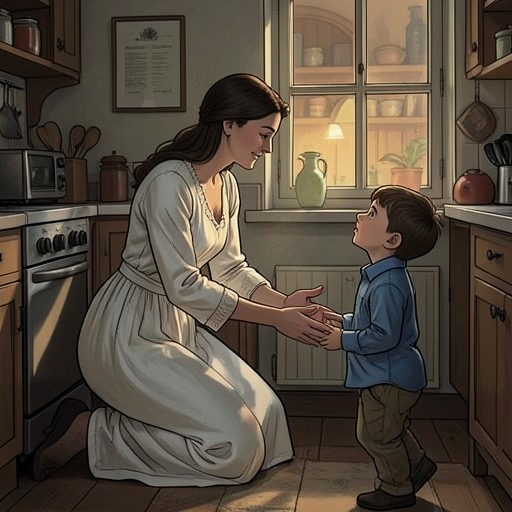
Delphine and Markus’s caregiving bond
The Master Butchers Singing ClubDelphine and Markus’s caregiving bond is a relationship of chosen family forged through grief and sustained by practical attention. After Eva’s death, Markus seeks out Delphine because she cared for his mother; Delphine responds by sheltering him, tending to needs he cannot easily explain, and finally deciding that he belongs with her. Their bond shows care passing from Eva to Delphine and then becoming a source of protection and belonging for her grieving son.
From Eva’s Care to Markus’s Refuge
Before Markus arrives, Delphine has already become part of the Waldvogel household through caring for Eva. As Eva’s illness advances, Delphine prepares the prescribed morphine solution, sterilizes the hypodermic needle, and learns to recognize the moment a dose is needed from Eva’s expression rather than from a timetable. Though she hates needles, she gives the medication and comforts Eva by massaging her sore hands. This intimate, skilled labor helps explain why Markus later sees Delphine not simply as someone who worked for his family, but as a person who had truly cared for his mother.
Eva’s death makes that work feel like both a farewell and a turning point. Delphine launders the family’s bloodstained and soiled clothes, presses Fidelis’s shirts as Eva once did, and recognizes the scale of the household labor Eva had managed. She has already decided that remaining in her old position without Eva is impossible. Tante is ready to step in, but Delphine’s attachment to the family and her inherited knowledge of its routines do not disappear with her decision to leave.
The connection becomes immediate when Markus, bruised and aching, slips away from Tante and makes the difficult journey to Delphine. Even before he arrives, Delphine finds herself cooking extra food, as though she expects him to need it. When Tante complains the next morning, Delphine does not reveal that the boy is hidden nearby. After Tante leaves, Delphine calls Markus out, and he runs to the window to ask whether his aunt is coming back. The question makes his need for safety plain without requiring him to explain everything that has happened.
Shelter, Trust, and the Meaning of Care
Delphine begins by meeting Markus’s immediate needs. She directs Cyprian to buy him overalls, then serves him pancakes with the last of the wild saskatoons, butter, and maple syrup. She tells him he can stay until his father returns and lets him decide whether to explain why he left. Instead, she asks why he came to her. Markus answers that she took care of Eva. His reason binds his trust in Delphine to her care for his mother: he believes that the person who loved and tended Eva may also protect him.
The refuge becomes a working household rather than a temporary hiding place. Markus helps Roy with yard work, joins games, and gradually lets his worries emerge. He fears that the chinchillas will be neglected or harmed and that Tante does not know how to prepare their food. Delphine listens without forcing a confession. When she learns that Markus has been sleeping on the floor and secretly washing himself and his clothes each morning, she understands that his distress began after Eva’s death and suspects that he has also been beaten. She recognizes the danger of involving the sheriff, warns Markus to hide if the sheriff comes, and offers practical help while keeping him under her roof.
Her care includes finding discreet ways to address problems Markus may find difficult to discuss directly. Delphine asks Cyprian to teach him how to urinate without wetting himself, understanding that the boy’s morning routine is connected to his shame and distress. She arranges for them to practise behind the henhouse, supplying a pitcher of lemonade for each. By the end of the week Markus is dry in the morning. Delphine has a further plan for helping him withstand Tante, but Fidelis’s return interrupts it. The episode shows her care as deliberate problem-solving: she attends to what Markus needs and tries to give him skills that might help him survive if he must return to his aunt.
Shared Grief and the Choice to Keep Him
Domestic routines give Markus a way to speak. Delphine notices that boys confide more readily when she is occupied with kitchen work, so she stretches out chores and lets conversation happen beside her rather than demanding it face-to-face. Over soup, Markus tells her about Ruthie, who died in the cellar, about sleeping inside the hill, and about his dreams and his mother. He also remembers Eva’s food. When Delphine says that she will never make Eva’s dumpling soup as well as Eva did, Markus reassures her that hers is good too. Delphine’s response is a rare, tender gesture: she strokes his hair.
The prospect of Markus being taken to Germany tests the bond. Delphine speaks of Spanish-orange marmalade, but admits that the ordinary subject conceals how broken up she feels about his departure. Markus leans his head against her arm. Delphine understands the gesture as another act of choosing her and decides that she will not let him go. Markus, meanwhile, cannot find the words to ask her to hide him or to persuade his father to change the plan; in his private despair, he feels like luggage being moved from place to place. The contrast between his inability to plead and Delphine’s resolve marks a change in their relationship: she no longer merely offers refuge while waiting for his father to return, but commits herself to keeping him.
When Markus later falls ill after being trapped in the hill, Delphine continues to care for him through a difficult recovery. She calls his condition earth sickness and imagines that the ground has drawn him toward the cold where his mother rests. When she realizes that his distant stare may be part of his recovery rather than something she must immediately interrupt, she stops trying to distract him with poems and games. She feeds him the dumpling soup Eva had taught her to make for sick boys, brings him into the sun, and keeps him near the light when frost settles outside. Her care changes with his needs: instead of demanding that he quickly return to his former self, she gives him space to think and grow back into his life.
A Continuing Family Bond
The bond persists as Markus grows older. Delphine recognizes that he uses the quiet companionship of kitchen chores to talk about experiences he might not share at a table. His memories of Eva become part of their shared life rather than a subject Delphine has to avoid. In listening, she also receives comfort: the food she learned from Eva becomes one way that mother and son remain connected, while Markus’s approval allows Delphine to inhabit that inheritance without pretending to replace Eva.
Delphine’s decision to claim Markus also has a wider emotional significance. Her own childhood loss left her longing for her mother, and she imagines the ground beneath Eva’s grave as a place where a child might hear the mother’s heart. She cannot undo Markus’s bereavement, and her care does not erase the history of his distress. What she can offer is dependable presence: food, shelter, attention, protection, and a willingness to let him speak—or remain silent—on his own terms. Their relationship makes kinship an act repeatedly performed, not merely a fact of birth: Markus comes to Delphine because of the care she gave Eva, and Delphine answers by making room for him in her life.